
B Lender Mortgage BC: Why Alternative Lenders Approve When Banks Decline
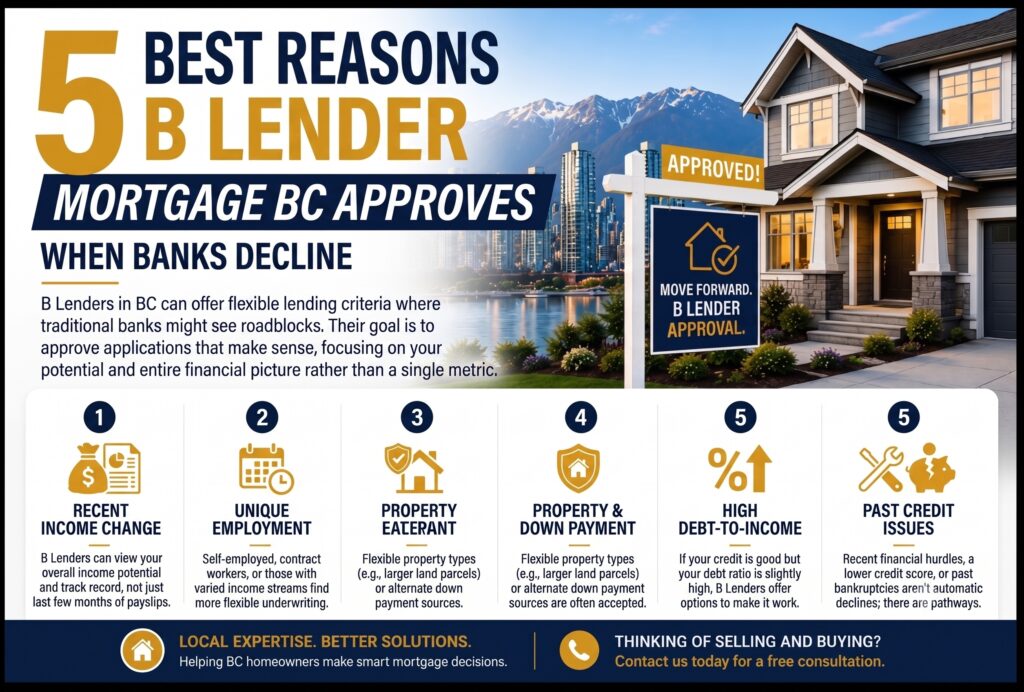
When traditional banks decline your mortgage application, a B lender mortgage BC provides a critical alternative. B lenders across British Columbia specialize in approving borrowers who fall outside traditional bank lending criteria due to credit challenges, non-traditional income, employment gaps, or other qualification issues. For homeowners and investors in Surrey, Langley, and the Lower Mainland facing mortgage decline from A lenders, understanding how B lender mortgage BC works can unlock homeownership or refinancing solutions that traditional banks refuse to offer.
Here is what you need to know about B lender mortgage BC.
What Distinguishes B Lender Mortgage BC From Traditional A Lenders?
Traditional A lenders are banks and credit unions that follow strict lending guidelines established by regulators and their own internal policies. They require minimum credit scores, documented income, employment stability, and debt ratios within defined parameters. Borrowers who fall outside these criteria simply cannot qualify for A lender mortgages regardless of circumstances.
B lenders operate with more flexible criteria specifically designed to serve borrowers who do not qualify with A lenders. B lender mortgage BC uses alternative qualification methods including bank statement analysis for self-employed borrowers, stated income verification for business owners, credit rebuilding consideration for those with past credit damage, and flexible employment history assessment for recent job changes or career transitions.
The fundamental difference is philosophy. A lenders minimize risk through strict criteria. B lenders manage risk through higher interest rates, larger down payment requirements, and more detailed file review while still approving borrowers A lenders decline. For B lender mortgage BC, the borrower’s current situation and ability to repay matter more than past credit perfection or traditional income documentation.
Who Qualifies for B Lender Mortgage BC?
B lender mortgage BC borrowers typically include self-employed individuals with strong income but complex tax returns showing minimal net income due to deductions, recent immigrants with Canadian employment but limited Canadian credit history, borrowers with credit scores between 600 and 680 who do not meet traditional lender minimums, individuals who experienced credit challenges but have rebuilt credit over one to two years, recent divorcees or separated individuals rebuilding credit and financial independence, and individuals with unstable employment history who nonetheless have stable current employment and income.
The common thread is that B lender mortgage BC borrowers can demonstrate ability and willingness to repay even though they do not meet traditional A lender requirements. They typically have reasonable down payments saved, equity in properties, or demonstrable income even if documentation is non-traditional.
B lender mortgage BC is not for individuals attempting to hide income, those with active fraud or criminal issues, or those with no legitimate means of repayment. B lenders conduct thorough due diligence and simply accept a broader range of qualification profiles than traditional banks.
Interest Rates and Costs for B Lender Mortgage BC
B lender mortgage BC interest rates are higher than traditional A lender rates to compensate for increased perceived risk. As of 2026, B lender mortgage BC rates typically range from 6.5 to 9 percent depending on credit score, down payment, and specific qualification profile. This represents 1 to 3 percent higher than comparable A lender rates.
On a 500,000 dollar mortgage, the rate difference between 5 percent (A lender) and 7 percent (B lender) results in approximately 300 dollars more monthly payment. Over five years, this totals 18,000 dollars in additional interest. However, for borrowers who cannot qualify for A lender mortgages at all, the B lender mortgage BC option makes the alternative difference between homeownership and renting.
B lender mortgage BC also involves lender fees typically ranging from 1 to 2 percent of the mortgage amount and broker fees of 1 to 2 percent. On a 500,000 dollar B lender mortgage BC, these fees total 10,000 to 20,000 dollars at funding. Many borrowers add these fees to the mortgage amount rather than paying them upfront.
Despite higher costs, B lender mortgage BC often provides the best available option when traditional financing is impossible. The key is viewing B lender mortgage BC as a stepping stone rather than permanent financing. Many borrowers use B lender mortgage BC initially, rebuild credit and income documentation over one to two years, then refinance into lower-cost A lender mortgages.
Down Payment Requirements for B Lender Mortgage BC
Most B lender mortgage BC programs require minimum down payments of 15 to 20 percent, higher than the 5 to 10 percent minimums many A lenders accept. This larger down payment requirement provides the lender with greater equity cushion given the higher perceived risk of the borrower profile.
For borrowers with particularly strong equity positions or excellent current income despite past credit challenges, some B lenders may accept 10 to 15 percent down on B lender mortgage BC. However, 20 percent down is more standard and results in better rates and terms than lower down payment B lender mortgage BC applications.
The larger down payment requirement for B lender mortgage BC is one reason why credit rebuilding and savings accumulation are so important for borrowers who anticipate needing B lender mortgage BC. The more down payment you can provide, the stronger your B lender mortgage BC application and the better the rates you receive.
Credit Rebuilding and B Lender Mortgage BC Qualification
For borrowers with credit challenges, B lender mortgage BC approval depends heavily on credit rebuilding demonstrated after the credit damaging event. B lenders want to see that the borrower has learned from past mistakes and now manages credit responsibly.
Effective credit rebuilding for B lender mortgage BC includes obtaining a secured credit card and using it responsibly for 12 to 24 months, making all current payments on time without exception, paying down existing debt to reduce debt ratios, becoming an authorized user on a family member’s well-managed credit card, and ensuring no new negative credit events occur while working toward B lender mortgage BC qualification.
For bankruptcy or consumer proposal situations, most B lenders require minimum one year after discharge before considering B lender mortgage BC. The longer the time elapsed with perfect payment history after a negative credit event, the more favorable your B lender mortgage BC terms and the higher your approval odds.
Self-Employment Income and B Lender Mortgage BC
One of the most valuable services B lender mortgage BC provides is approval for self-employed borrowers that traditional A lenders decline. Where A lenders require two years of consistent tax returns with increasing income trends, B lenders use bank statement analysis to verify actual income flow regardless of tax return net income figures.
For self-employed borrowers whose tax returns show minimal net income due to legitimate business expense deductions, B lender mortgage BC can be the only viable option. B lenders look at business bank deposits over 12 to 24 months to confirm actual earnings exceed what appears on tax returns, then use the actual income for B lender mortgage BC qualification rather than the reduced tax return numbers.
This approach makes sense for self-employed individuals, contractors, real estate investors, and business owners across the Lower Mainland who generate strong income but report lower taxable income due to deductions. B lender mortgage BC specifically serves this borrower demographic where traditional A lenders simply say no.
When to Use B Lender Mortgage BC vs Private Mortgage BC
B lender mortgage BC and private mortgage BC both serve borrowers who do not qualify with A lenders, but they serve different purposes. B lender mortgage BC focuses on borrower income and credit qualification using alternative methods. If you can demonstrate income and have credit you can explain, B lender mortgage BC usually offers better rates and terms than private mortgage BC.
Private mortgage BC focuses on property equity. If you have substantial equity but cannot document income or your credit is beyond explanation, private mortgage BC may be your only option. However, private mortgage BC rates are typically 2 to 4 percent higher than B lender mortgage BC rates.
Many borrowers strategically use B lender mortgage BC first, demonstrating on-time payments for 12 to 24 months while rebuilding credit and strengthening income documentation. They then refinance into lower-cost A lender mortgages. Some borrowers start with private mortgage BC, then graduate to B lender mortgage BC as their situation stabilizes, ultimately reaching A lender status. The path depends on individual circumstances.
Regulation and Consumer Protection for B Lender Mortgage BC
B lenders in British Columbia are regulated by provincial regulators and must comply with lending standards and disclosure requirements. Mortgage brokers arranging B lender mortgage BC are licensed and regulated by the Financial Services Regulatory Authority of BC, which enforces professional standards and consumer protection.
Working with a licensed broker experienced in B lender mortgage BC ensures you understand the rates, terms, and all costs associated with your B lender mortgage BC before committing.
For additional information about B lender mortgage BC regulations in British Columbia, visit the Financial Services Regulatory Authority of BC at fsrao.ca or review mortgage resources through the Canada Mortgage and Housing Corporation at cmhc-schl.gc.ca.
Let’s Discuss Your B Lender Mortgage BC Options
If traditional A lenders have declined your mortgage application, B lender mortgage BC may provide the approval you need. The key is understanding which B lenders specialize in your specific situation, whether income documentation, credit rebuilding, or employment stability is your primary concern, and how to position your application for strongest approval odds.
I work with B lender mortgage BC scenarios regularly throughout the Lower Mainland and Calgary. My approach is to assess why A lenders declined your application, identify which B lenders are most likely to approve your profile, and help you prepare a strong application that results in approval at the best available B lender mortgage BC rates.
For more information about B lender mortgage BC, visit https://greghorvath.ca/private-financing/
Book a consultation at greghorvath.ca. There is no cost and no obligation. Let’s discuss your B lender mortgage BC situation and find the alternative lending solution that works for you.
