
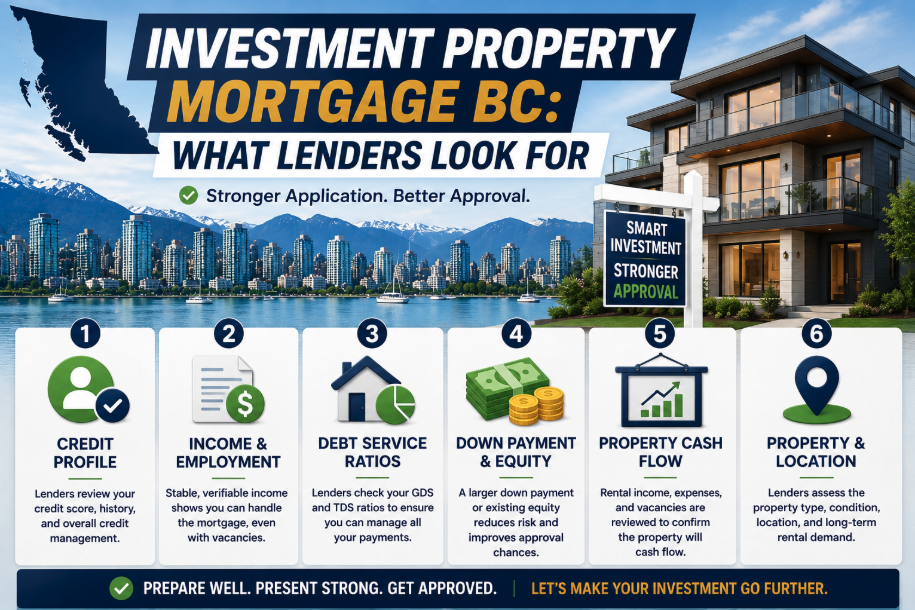
Investment Property Mortgage BC: What Lenders Look For When Financing Rental Properties
Securing an investment property mortgage BC requires meeting different qualification criteria than financing a primary residence. Lenders across Surrey, Langley, and the Lower Mainland assess rental property mortgages with additional scrutiny because investment properties carry higher default risk than owner-occupied homes. Understanding what lenders evaluate when considering an investment property mortgage BC helps investors position their applications for approval and secure favorable rates.
Here is what lenders look for when evaluating investment property mortgage BC applications.
Higher Down Payment Requirements for Investment Property Mortgage BC
Traditional lenders require larger down payments for investment property mortgage BC compared to primary residence mortgages. While you can purchase an owner-occupied home in British Columbia with as little as 5 percent down if you qualify for CMHC insurance, investment property mortgage BC through traditional lenders typically requires minimum 20 percent down.
Many lenders prefer 25 to 30 percent down for investment property mortgage BC to provide additional equity cushion. This larger down payment requirement reflects the higher risk lenders associate with rental properties. If rental income falls short or the property sits vacant, investors are statistically more likely to default on an investment property mortgage BC than on their primary residence mortgage.
For investors in high-value markets like Vancouver, Surrey, Burnaby, and other Lower Mainland locations, the 20 to 30 percent down payment requirement represents substantial capital. A 1 million dollar investment property requires 200,000 to 300,000 dollars down before considering closing costs and reserves.
Alternative lenders including B lenders and private lenders may provide investment property mortgage BC with lower down payments, though rates increase as down payment decreases. Private lenders sometimes finance investment property mortgage BC up to 75 to 80 percent loan-to-value for strong deals in desirable locations.
Rental Income Calculation for Investment Property Mortgage BC
When evaluating investment property mortgage BC applications, lenders assess whether the rental income from the property will cover or substantially offset the mortgage payment, property taxes, insurance, and maintenance costs. However, lenders do not simply accept stated rental income at face value.
Traditional lenders typically apply a haircut to rental income for investment property mortgage BC qualification. Common approaches include using 50 percent of stated rental income to account for vacancy, maintenance, and management costs, using 80 percent of market rent based on rental comparables rather than optimistic projections, or requiring a signed lease agreement showing actual rental income before closing.
For investment property mortgage BC on properties not yet rented, lenders order rental assessments from licensed appraisers to determine market rent. They use this conservative market rent figure reduced by the haircut percentage rather than your projections of what you hope to achieve.
Self-employed investors seeking investment property mortgage BC face additional complexity because lenders also haircut the investor’s personal income from their business using the same tax return analysis applied to any self-employed mortgage application. The combination of reduced rental income recognition and reduced personal income recognition makes investment property mortgage BC qualification particularly challenging for self-employed real estate investors.
Debt Service Ratios Are Stricter for Investment Property Mortgage BC
Lenders use Gross Debt Service and Total Debt Service ratios to assess whether you can afford mortgage payments. For investment property mortgage BC, lenders apply stricter ratio limits than for owner-occupied properties.
Traditional lenders typically allow Total Debt Service ratios up to 42 to 44 percent for primary residence mortgages. For investment property mortgage BC, many lenders cap TDS at 39 to 42 percent. This tighter limit means you need stronger income or lower existing debt to qualify for investment property mortgage BC compared to qualifying for an equivalent primary residence mortgage.
The rental income from the investment property is added to your income for ratio calculation purposes, but as discussed above, it is reduced by 20 to 50 percent first. This means the property needs to generate substantially more rent than the mortgage payment costs to actually improve your debt service ratios for investment property mortgage BC qualification.
For investors in Surrey, Langley, and the Lower Mainland where property prices are high relative to rental income, achieving positive debt service contribution from investment property mortgage BC is challenging. Many investment properties in these markets generate rental income that covers only 60 to 80 percent of total carrying costs, meaning the property actually worsens your debt service ratios even after lender haircuts are applied.
Credit Score and Financial Reserves for Investment Property Mortgage BC
Lenders expect higher credit scores for investment property mortgage BC than for primary residence mortgages. While you might qualify for an owner-occupied mortgage with a 650 credit score through some lenders, investment property mortgage BC typically requires minimum 680 to 700 credit score for traditional lender approval.
Financial reserves are also critical for investment property mortgage BC. Lenders want to see that you have liquid assets beyond the down payment to cover unexpected expenses, vacancy periods, or mortgage payments if rental income falls short. Typical reserve requirements for investment property mortgage BC include three to six months of mortgage payments, property taxes, and insurance in liquid accessible accounts.
For investors purchasing multiple properties or building a rental portfolio, reserve requirements compound. If you own three investment properties and are applying for investment property mortgage BC on a fourth, lenders may require reserves covering all four properties simultaneously, not just the new purchase.
Property Condition and Location Impact Investment Property Mortgage BC Approval
Lenders are more selective about property condition and location for investment property mortgage BC than for owner-occupied mortgages. Properties requiring significant repairs, properties in markets with weak rental demand, or properties with unusual characteristics face higher scrutiny or outright decline for investment property mortgage BC.
Traditional lenders prefer investment property mortgage BC on properties that are move-in ready or require only minor cosmetic updates. Properties needing major renovations, system replacements, or structural work typically do not qualify for traditional investment property mortgage BC until repairs are complete.
Location matters significantly for investment property mortgage BC approval. Properties in strong rental markets like Vancouver, Burnaby, Surrey, and Langley with consistent tenant demand and stable property values get more favorable treatment than properties in smaller communities or markets with declining populations or weak employment.
Alternative lenders and private lenders provide more flexibility on property condition for investment property mortgage BC. Private lenders in particular will finance properties requiring substantial renovation or in less conventional locations, though at higher rates and with lower loan-to-value ratios.
Alternative Lenders for Investment Property Mortgage BC When Traditional Approval Is Difficult
Real estate investors often struggle with traditional investment property mortgage BC approval due to self-employment income, multiple properties impacting debt service ratios, properties requiring renovation, or aggressive portfolio growth that outpaces traditional qualification capacity.
B lenders provide investment property mortgage BC with more flexible income verification, higher acceptable debt service ratios, and willingness to work with investors building portfolios aggressively. B lender investment property mortgage BC rates typically run 1 to 3 percent higher than traditional bank rates.
Private lenders focus primarily on property equity and rental income potential rather than borrower income and credit. Private investment property mortgage BC can finance properties that traditional and B lenders decline due to condition issues, location, or borrower qualification challenges. Private rates range from 8 to 12 percent with terms of one to two years, providing bridge financing while investors stabilize properties or strengthen their qualification profile for refinancing into lower-cost options.
Many successful real estate investors in Surrey, Langley, and the Lower Mainland use a combination of traditional, B lender, and private investment property mortgage BC financing across their portfolios, matching each property to the most appropriate lender type based on the property characteristics and their qualification situation at the time of purchase.
Regulation and Consumer Protection for Investment Property Mortgage BC
Whether seeking investment property mortgage BC through traditional banks, B lenders, or private lenders, investors benefit from regulatory oversight. Mortgage brokers in British Columbia are licensed and regulated by the Financial Services Regulatory Authority of BC, which enforces professional standards and consumer protection.
Working with a mortgage broker experienced in investment property mortgage BC ensures you understand your options across lender types and helps you structure deals to maximize approval odds while minimizing costs.
For additional information about investment property mortgage BC regulations in British Columbia, visit the Financial Services Regulatory Authority of BC at fsrao.ca or review mortgage resources through the Canada Mortgage and Housing Corporation at cmhc-schl.gc.ca.
Let’s Discuss Your Investment Property Mortgage BC Needs
If you are building a rental property portfolio in Surrey, Langley, or elsewhere in the Lower Mainland, understanding investment property mortgage BC qualification requirements and knowing which lenders work best for your situation helps you grow your portfolio efficiently.
I work with investment property mortgage BC scenarios regularly throughout the Lower Mainland and Calgary. My approach is to review your portfolio, assess your qualification profile, and help you determine which lenders and mortgage structures make sense for your investment goals.
For more information about investment property mortgage BC and rental property financing, visit https://greghorvath.ca/private-financing/
Book a consultation at greghorvath.ca. There is no cost and no obligation. Let’s discuss your investment property mortgage BC needs and find the best financing approach for your real estate investing strategy.
