
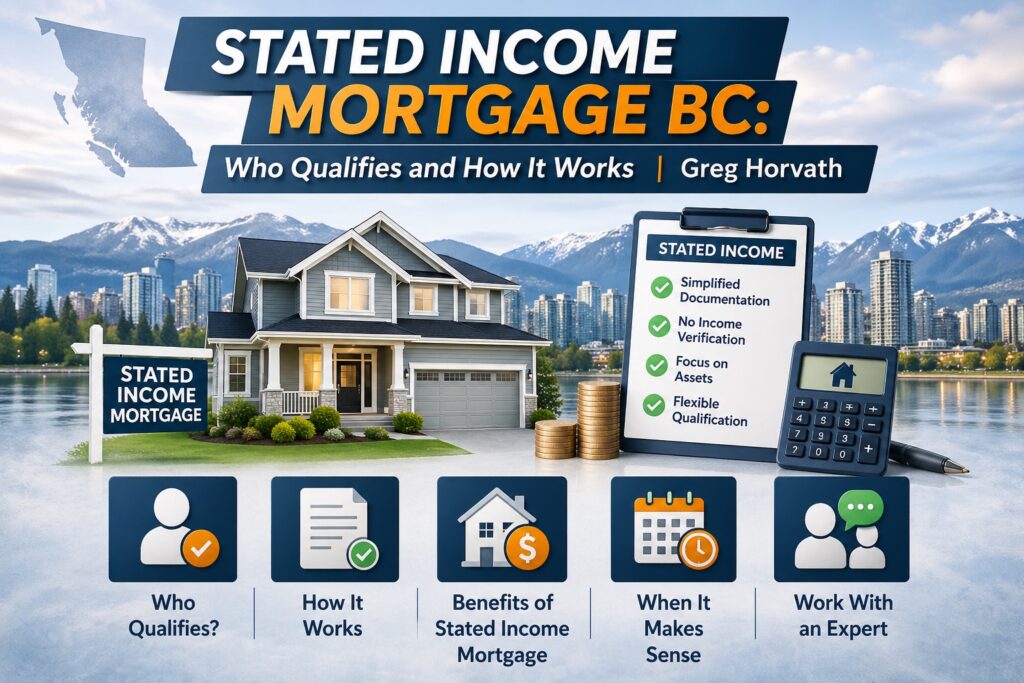
Stated Income Mortgage BC: Who Qualifies and How It Works
A stated income mortgage BC allows self-employed borrowers, business owners, and others with non-traditional income to qualify for mortgage financing without providing tax returns or traditional income documentation. For entrepreneurs, commissioned sales professionals, and incorporated business owners across Surrey, Langley, and the Lower Mainland, stated income mortgage BC programs provide access to financing that reflects actual earnings rather than tax-minimized reported income.
Understanding who qualifies for a stated income mortgage BC and how these programs work helps borrowers determine if this alternative lending approach fits their situation.
What Is a Stated Income Mortgage BC and How Does It Work?
A stated income mortgage BC is a mortgage product where the lender approves your application based on income you declare rather than income documented through tax returns or pay stubs. You state what you earn, and the lender applies reasonability testing to verify that your stated income makes sense given your industry, occupation, business structure, and geographic market.
Stated income mortgage BC lenders typically require you to provide evidence that you operate the business or work in the capacity you claim, such as business registration documents, contracts, client lists, or business bank statements showing revenue flow. However, they do not require Notice of Assessment from the Canada Revenue Agency or traditional income verification documents.
The lender assesses whether your stated income is reasonable and credible. For example, if you state you earn 200,000 dollars annually as a self-employed plumber in Surrey, the lender reviews industry standards, your years in business, the client base you describe, and other factors to determine if that income claim is plausible. If it passes reasonability testing, the stated income mortgage BC application proceeds based on that income figure.
This approach solves a critical problem for self-employed borrowers and business owners who earn strong income but minimize taxable income through legitimate business expense deductions, retained earnings in corporations, or other tax planning strategies.
Who Qualifies for Stated Income Mortgage BC?
Stated income mortgage BC programs are designed for borrowers whose actual earnings exceed their reported taxable income. Common profiles who qualify for stated income mortgage BC include self-employed professionals who write off substantial business expenses, incorporated business owners who retain earnings inside the corporation rather than drawing salary, commissioned sales professionals with variable income that does not show consistently on traditional documentation, contractors and gig economy workers with strong cash flow but complex income reporting, and real estate investors with rental income offset by depreciation and expenses on tax returns.
To qualify for a stated income mortgage BC, you typically need a minimum credit score of 600 to 650 depending on the lender, at least two years of self-employment or business ownership history, down payment of at least 20 percent from your own resources, and ability to demonstrate that your stated income is reasonable and credible for your industry and situation.
Stated income mortgage BC is not appropriate for borrowers attempting to inflate income beyond what they actually earn or for those who cannot provide any supporting documentation of their business or occupation. Lenders apply fraud prevention measures and will decline applications where stated income appears inflated or unsupportable.
How Lenders Verify Stated Income for Stated Income Mortgage BC
While stated income mortgage BC does not require tax returns, lenders do verify your stated income through alternative methods. Common verification approaches for stated income mortgage BC include reviewing business bank statements to confirm revenue flow matches stated income levels, examining contracts, invoices, or client agreements showing ongoing business activity, verifying business registration and licensing appropriate to your stated occupation, requesting accountant letters confirming you operate the business and that stated income is reasonable, and applying industry benchmarking to compare your stated income against typical earnings for your profession and experience level.
For a stated income mortgage BC in British Columbia, the lender wants confidence that you actually earn what you claim and can afford the mortgage payments. They achieve this confidence through documentation that falls short of full income verification but exceeds simple declaration without any supporting evidence.
The more documentation you can provide showing business activity, revenue flow, and industry-standard earnings, the stronger your stated income mortgage BC application becomes. Borrowers who can show consistent deposits in business accounts, multiple years of business operation, and professional credentials supporting their stated occupation improve approval odds and may secure better rates.
Stated Income Mortgage BC Interest Rates and Costs
Interest rates for stated income mortgage BC are higher than traditional bank mortgage rates because lenders take on additional risk by approving applications without full income verification. Stated income mortgage BC rates typically range from 1 to 3 percent higher than traditional mortgage rates, putting them in the 7 to 9 percent range as of early 2026.
Lenders offering stated income mortgage BC also typically charge lender fees of 1 to 2 percent of the mortgage amount at funding. Broker fees may add another 1 to 2 percent. On a 600,000 dollar stated income mortgage BC, this means 12,000 to 24,000 dollars in upfront fees in addition to the ongoing higher interest rate.
While these costs are higher than traditional financing, they are typically lower than private mortgage costs. Stated income mortgage BC occupies the middle ground between traditional bank mortgages and private mortgages, offering more accessible approval than banks but at better rates than private lenders for borrowers who can meet the stated income mortgage BC qualification criteria.
Many borrowers use stated income mortgage BC for initial purchase or refinancing, then work to position themselves for traditional financing at renewal by adjusting how they structure income or by building sufficient equity to qualify through other alternative lending programs with better rates.
Down Payment Requirements for Stated Income Mortgage BC
Most stated income mortgage BC lenders require a minimum 20 percent down payment from the borrower’s own verified resources. This down payment requirement serves two purposes. First, it demonstrates the borrower has genuine skin in the game and financial capacity beyond stated income. Second, it provides the lender with an equity cushion that reduces risk.
The down payment for stated income mortgage BC must come from legitimate sources that can be verified. Acceptable down payment sources for stated income mortgage BC include savings in bank accounts held in your name, proceeds from sale of previous property, gifted funds from immediate family members with proper gift letters, or funds from sale of business assets or investments.
Borrowed down payments are generally not acceptable for stated income mortgage BC. Lenders want to see that you have accumulated the down payment through your business earnings or other legitimate sources rather than simply borrowing the funds immediately before purchase.
In some cases, borrowers with particularly strong applications or properties in desirable locations like Vancouver, Surrey, or other Lower Mainland markets may qualify for stated income mortgage BC with 15 percent down, but 20 percent is the standard minimum across most lenders.
Stated Income Mortgage BC for Purchases vs Refinances
Stated income mortgage BC works for both property purchases and refinances, though the application focus differs slightly between the two scenarios.
For stated income mortgage BC purchases, lenders focus heavily on your down payment source, the property location and type, and whether your stated income reasonably supports the proposed purchase price and mortgage payment. They want confidence you can afford the property and that the transaction makes financial sense.
For stated income mortgage BC refinances, lenders focus more on the equity you have built in the property and what you plan to do with the refinanced funds. Common reasons for stated income mortgage BC refinancing include consolidating high-interest business or personal debt, accessing equity for business expansion or investment, removing a co-borrower from title after separation or divorce, or simply securing better terms than a maturing private mortgage.
In both purchase and refinance scenarios, stated income mortgage BC provides solutions for self-employed borrowers and business owners in Surrey, Langley, and throughout the Lower Mainland who cannot qualify through traditional income verification but have legitimate earnings and strong equity positions.
Alternatives to Stated Income Mortgage BC for Self-Employed Borrowers
Stated income mortgage BC is not the only option for self-employed borrowers who cannot qualify through traditional income documentation. Other alternative approaches include B lender programs that use bank statement analysis rather than tax returns to verify income, private mortgages that require no income verification and approve based purely on equity, adjusting business structure to show more income on tax returns for future qualification, or waiting until you have two full tax years showing sufficient income to qualify traditionally.
Working with a mortgage broker who understands both traditional and alternative lending helps you compare these options and choose the approach that balances approval certainty with cost. In some cases, making small adjustments to how you draw income or waiting a few months to show additional tax year history can qualify you for programs with significantly better rates than stated income mortgage BC.
Regulation and Consumer Protection for Stated Income Mortgage BC
Stated income mortgage BC lenders operate under the same regulatory framework as traditional mortgage lenders in British Columbia. Mortgage brokers arranging stated income mortgage BC are licensed and regulated by the Financial Services Regulatory Authority of BC, which enforces professional standards and consumer protection requirements.
Working with a licensed broker when pursuing stated income mortgage BC ensures you receive transparent information about costs, terms, and obligations. Brokers have access to multiple stated income mortgage BC lenders and can compare programs to find the best available option for your situation.
For additional information about mortgage lending regulations in British Columbia, visit the Financial Services Regulatory Authority of BC at fsrao.ca or review mortgage resources through the Canada Mortgage and Housing Corporation at cmhc-schl.gc.ca.
Let’s Determine if Stated Income Mortgage BC Fits Your Situation
If you are self-employed, own a business, or have non-traditional income that does not show on tax returns at levels reflecting your actual earnings, stated income mortgage BC may provide the mortgage solution you need. The first step is reviewing your income situation, down payment capacity, and overall qualification profile to determine if stated income mortgage BC is the right approach or if other alternatives serve you better.
I work with stated income mortgage BC and other alternative lending programs regularly throughout Surrey, Langley, the Lower Mainland, and Calgary. My approach is to understand your business structure and income situation, explain which stated income mortgage BC programs you qualify for, and help you determine whether stated income mortgage BC offers the best balance of approval certainty and cost for your needs.
For more information about stated income mortgage BC and alternative lending for self-employed borrowers, visit https://greghorvath.ca/private-financing/
Book a consultation at greghorvath.ca. There is no cost and no obligation. Let’s review your income situation and determine if stated income mortgage BC makes sense for your financing needs.
