
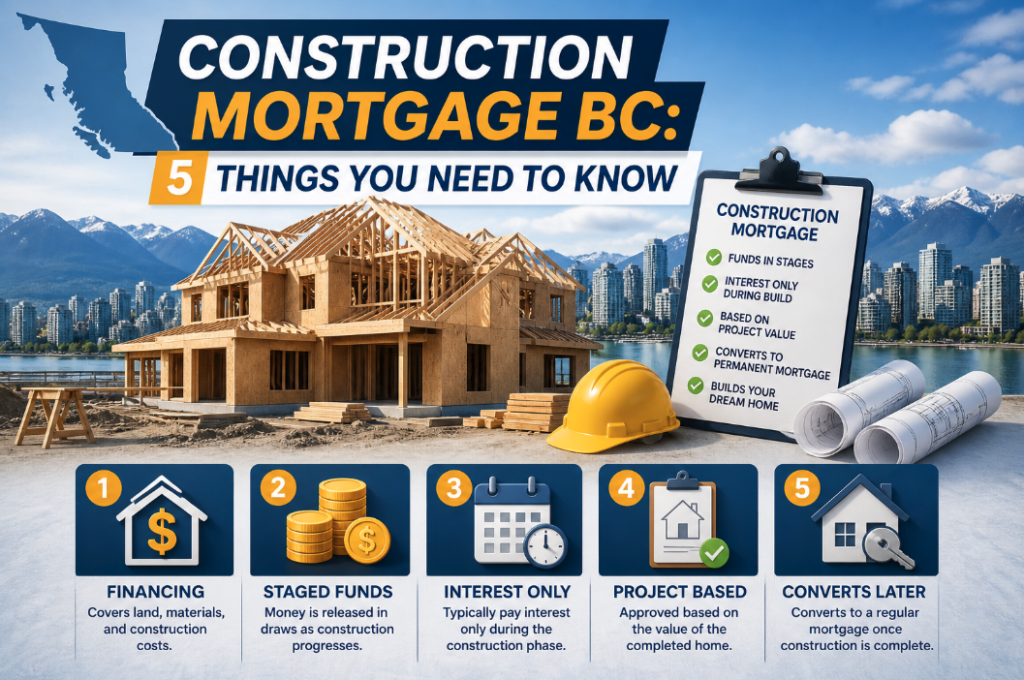
Construction Mortgage BC: 5 Things You Need to Know About Private Construction Financing
Securing a construction mortgage BC through traditional banks can be nearly impossible for builders and homeowners who do not fit standard lending criteria. Private construction financing provides an alternative path for construction projects in Surrey, Langley, and the Lower Mainland when traditional construction mortgage BC approval is out of reach. Understanding how private construction mortgage BC works and what lenders require helps builders and property owners access the capital needed to complete projects.
Here are five critical things you need to know about construction mortgage BC through private lenders.
Private Construction Mortgage BC Focuses on Exit Strategy and Equity
Traditional bank construction mortgage BC programs evaluate your credit score, income documentation, detailed construction plans, contractor credentials, and extensive project specifications. Private construction mortgage BC lenders take a different approach. They focus primarily on the exit strategy for repaying the loan and the equity or collateral securing the financing.
For a construction mortgage BC through private lenders, the key questions are what is the property or project worth upon completion, how will the construction mortgage BC be repaid when the project finishes, and what equity or security protects the lender if the project encounters problems.
Private construction mortgage BC lenders want confidence that the completed project will have sufficient value to support refinancing into permanent financing or sale at a price that repays the construction loan with a reasonable margin. If you can demonstrate a credible exit strategy and provide adequate security, private construction mortgage BC approval becomes accessible even with credit challenges, non-traditional income, or project characteristics that traditional lenders reject.
Common scenarios where private construction mortgage BC makes sense include builders who cannot qualify for traditional construction financing due to credit or income documentation issues, homeowners undertaking major renovations or additions that exceed traditional construction mortgage BC limits, investors acquiring properties requiring significant construction work before they can be rented or sold, and projects on unique properties or in locations where traditional construction mortgage BC is unavailable.
Construction Mortgage BC Advances Happen in Stages Based on Completion
Private construction mortgage BC operates through a draw or advance structure where funds are released in stages as construction progresses rather than providing the full loan amount upfront. This staged funding protects the lender by ensuring money is only advanced as work is completed and value is added to the property.
Typical construction mortgage BC draw schedules might include an initial advance at the start of construction covering land acquisition or initial costs if applicable, progress draws at defined completion milestones such as foundation complete, framing complete, rough-ins complete, and final advance upon substantial completion and readiness for occupancy or sale.
Each draw request for a construction mortgage BC requires documentation showing the work claimed has been completed. Private lenders typically conduct site inspections or require third-party inspector reports before releasing funds. Some construction mortgage BC lenders advance funds directly to contractors and suppliers rather than to the borrower to ensure money goes toward actual construction costs.
Understanding the draw structure before starting your project is critical. You need sufficient working capital to fund construction between draws since construction mortgage BC advances happen after work is completed, not before. Builders and homeowners in Surrey, Langley, and the Lower Mainland undertaking construction with private construction mortgage BC must plan cash flow carefully to avoid delays waiting for draw approvals.
Interest Rates and Fees for Construction Mortgage BC Are Higher Than Traditional Financing
Private construction mortgage BC carries significantly higher costs than traditional bank construction financing. Interest rates for construction mortgage BC through private lenders typically range from 10 to 15 percent depending on the project risk profile, your equity position, and the strength of your exit strategy.
In addition to interest, construction mortgage BC through private lenders involves substantial upfront fees. Lender fees typically range from 2 to 4 percent of the total construction mortgage BC amount. Broker fees add another 2 to 3 percent. Appraisal costs, legal fees, and inspection fees throughout construction add additional expenses.
On a construction mortgage BC of 500,000 dollars, upfront fees might total 25,000 to 35,000 dollars before considering interest charges during the construction period. These costs are substantially higher than traditional construction mortgage BC, but they provide access to financing when no other construction mortgage BC options exist.
Most borrowers view private construction mortgage BC as short-term bridge financing. The plan is to use the construction mortgage BC to complete the project, then refinance into lower-cost permanent financing or sell the completed property and repay the construction mortgage BC from proceeds. The higher costs are acceptable for the 6 to 18 month construction period if they enable a project that generates value or solves a problem that could not otherwise be addressed.
Construction Mortgage BC Requires Detailed Project Planning and Documentation
While private construction mortgage BC approval criteria differ from traditional lenders, you still need thorough project planning and documentation. Private lenders want to see detailed construction budgets breaking down all costs, realistic construction timelines with milestones aligned to draw schedule, building permits and municipal approvals in place before funding, qualified contractors with track records and proper licensing, and comprehensive plans and specifications for the work being undertaken.
The lender uses this documentation to assess whether your construction budget is realistic, whether your timeline is achievable, and whether the completed project will have the value you project for refinancing or sale purposes. Incomplete or unrealistic project documentation leads to construction mortgage BC decline even from private lenders.
For homeowners undertaking renovations or additions in Surrey, Langley, or elsewhere in the Lower Mainland, working with experienced contractors who can provide detailed scopes of work and accurate cost estimates is critical for construction mortgage BC approval. For builders and developers, demonstrating a track record of successful project completion strengthens your construction mortgage BC application significantly.
Exit Strategy Determines Construction Mortgage BC Approval and Terms
The single most important factor in private construction mortgage BC approval is your exit strategy for repaying the loan when construction completes. Lenders need confidence the construction mortgage BC will be repaid on time without requiring foreclosure or forced sale.
Strong exit strategies for construction mortgage BC include refinancing into traditional or B lender permanent financing once construction completes and the property qualifies for conventional lending, selling the completed property with pre-arranged buyers or strong market demand supporting quick sale, generating rental income from the completed property sufficient to qualify for permanent financing, or repaying the construction mortgage BC from other sources such as business cash flow or sale of other assets.
The more concrete and documented your exit strategy, the better your construction mortgage BC approval odds and terms. A builder who has a pre-sale agreement or firm offers on a completed spec home will secure better construction mortgage BC terms than a builder hoping to sell the completed home on the open market with no pre-arranged buyer.
Similarly, a homeowner planning to refinance their primary residence after completing a renovation-based construction mortgage BC project will get better terms if they can show pre-qualification or commitment from a permanent lender willing to refinance once work is complete.
Alternative Options to Construction Mortgage BC for Smaller Projects
Not every construction or renovation project requires a formal construction mortgage BC. For smaller projects, alternative financing approaches may provide simpler and potentially lower-cost access to capital.
Home equity lines of credit can fund renovations or construction for homeowners who qualify based on existing equity, credit, and income. A HELOC provides flexible draw capability without the staged inspection requirements of construction mortgage BC, though the funds must be repaid through your own cash flow rather than through project completion and refinancing.
Private mortgages that are not structured specifically as construction mortgage BC can provide lump sum capital for projects where you have other resources to fund construction and simply need to access equity to cover costs. This approach works when you can self-fund the construction timeline and use the private mortgage to consolidate costs after completion or at specific milestones.
For very small renovation projects, personal loans or credit lines may provide adequate capital without the complexity and cost of construction mortgage BC financing. The determination depends on project size, your qualification profile, and the amount of equity you need to access.
Regulation and Consumer Protection for Construction Mortgage BC
Whether pursuing traditional or private construction mortgage BC, borrowers in British Columbia benefit from regulatory oversight. Mortgage brokers are licensed and regulated by the Financial Services Regulatory Authority of BC, which enforces professional standards and consumer protection requirements.
Working with a licensed broker when seeking construction mortgage BC ensures you receive transparent information about costs, terms, draw schedules, and lender requirements. Brokers experienced in construction mortgage BC can help you structure your project documentation and exit strategy to maximize approval odds.
For additional information about construction mortgage BC regulations in British Columbia, visit the Financial Services Regulatory Authority of BC at fsrao.ca or review mortgage resources through the Canada Mortgage and Housing Corporation at cmhc-schl.gc.ca.
Let’s Discuss Your Construction Mortgage BC Needs
If you are planning a construction project in Surrey, Langley, or the Lower Mainland and need financing outside traditional bank construction mortgage BC programs, private construction financing may provide the solution. The key is proper project planning, realistic budgeting, and a credible exit strategy for repayment.
I work with construction mortgage BC scenarios regularly throughout the Lower Mainland and Calgary. My approach is to review your project plans, assess your financing needs and exit strategy, and help you determine whether private construction mortgage BC is appropriate or if alternative financing structures better serve your situation.
For more information about construction mortgage BC and alternative financing for construction projects, visit https://greghorvath.ca/private-financing/
Book a consultation at greghorvath.ca. There is no cost and no obligation. Let’s review your construction project and determine the best financing approach for your specific situation.
